Probability Theory Courses
Courses in Probability Theory can help you learn statistical reasoning, random variables, and probability distributions. You can build skills in hypothesis testing, regression analysis, and decision-making under uncertainty. Many courses introduce tools like R, Python, and Excel, that support analyzing data and modeling real-world phenomena. You'll explore key topics such as Bayes' theorem, expected value, and the law of large numbers, all of which are crucial for applications in fields like finance, engineering, and artificial intelligence.
Popular Probability Theory Courses and Certifications
 Status: NewStatus: Free Trial
University of Colorado Boulder
Skills you'll gain: Probability, Statistical Inference, Estimation, Statistical Methods, Probability & Statistics, Statistics, Probability Distribution, Markov Model, Data Literacy, Statistical Analysis, Bayesian Statistics, Sampling (Statistics), Applied Mathematics, Artificial Intelligence, Generative AI, Data Science, Theoretical Computer Science, Data Analysis, Machine Learning Algorithms, Mathematical Theory & Analysis
 Status: Free Trial
Johns Hopkins University
Skills you'll gain: R Programming, Statistical Analysis, Statistical Programming, Data Analysis, Probability, Probability Distribution, Applied Machine Learning, Probability & Statistics, Applied Mathematics, Data Science, Computational Thinking, Simulations
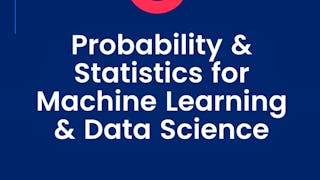 Status: Free Trial
DeepLearning.AI
Skills you'll gain: Descriptive Statistics, Bayesian Statistics, Statistical Hypothesis Testing, Probability & Statistics, Sampling (Statistics), Probability Distribution, Probability, Statistical Inference, A/B Testing, Statistical Analysis, Statistical Machine Learning, Data Science, Statistical Modeling, Exploratory Data Analysis, Statistical Visualization
 Status: Preview
University of Zurich
Skills you'll gain: Probability, Probability Distribution, Probability & Statistics, Statistics, Descriptive Statistics, Applied Mathematics, Risk Analysis, Finance
 Status: NewStatus: Free Trial
University of Pittsburgh
Skills you'll gain: Probability Distribution, Data Science, Probability & Statistics, Predictive Analytics, Probability, Statistical Modeling, Data Analysis, Regression Analysis, Logistic Regression, Statistical Analysis, Statistical Methods, Statistical Machine Learning, Bayesian Statistics, Statistical Inference, Feature Engineering, Applied Mathematics, Python Programming, Machine Learning, Algorithms
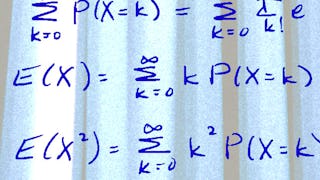 Status: Free Trial
University of Colorado Boulder
Skills you'll gain: Probability, Probability & Statistics, Probability Distribution, Bayesian Statistics, Data Analysis, Descriptive Statistics, Statistical Analysis, Artificial Intelligence, Data Collection
What brings you to Coursera today?
 Status: Free Trial
University of California San Diego
Skills you'll gain: Combinatorics, Probability, Probability Distribution, Algorithms, Bayesian Statistics, Mathematical Modeling, Statistics, Arithmetic, Python Programming, Simulations
 Status: Free Trial
Stanford University
Skills you'll gain: Bayesian Network, Applied Machine Learning, Graph Theory, Machine Learning Algorithms, Probability Distribution, Network Model, Bayesian Statistics, Statistical Modeling, Markov Model, Decision Support Systems, Machine Learning, Probability & Statistics, Network Analysis, Machine Learning Methods, Statistical Inference, Sampling (Statistics), Statistical Methods, Algorithms, Model Evaluation, Computational Thinking
 Status: Preview
Stanford University
Skills you'll gain: Game Theory, Mathematical Modeling, Graph Theory, Bayesian Statistics, Behavioral Economics, Probability, Economics, Problem Solving, Algorithms, Probability Distribution
 Status: NewStatus: Free Trial
Arizona State University
Skills you'll gain: Probability & Statistics, Analytical Skills, Exploratory Data Analysis, Estimation, Logistic Regression
 Status: Free Trial
Arizona State University
Skills you'll gain: Experimentation, Sample Size Determination, Research Design, Regression Analysis, Statistical Analysis, Statistical Methods, Data Analysis Software, Statistical Modeling, Statistical Hypothesis Testing, Design Strategies, Sampling (Statistics), Probability & Statistics, Mathematical Modeling, Analysis, Model Evaluation, Data Transformation, Descriptive Statistics, Probability Distribution, Variance Analysis, Data Analysis
 Status: Free Trial
Johns Hopkins University
Skills you'll gain: Precision Medicine, Game Theory, Reinforcement Learning, Data-Driven Decision-Making, Clinical Trials, Bioinformatics, Data Analysis, Image Analysis, Analytics, Markov Model, Bayesian Statistics, Time Series Analysis and Forecasting, Forecasting, Data Science, Strategic Decision-Making, Statistical Methods, Anomaly Detection, Applied Machine Learning, Cybersecurity, Statistical Analysis
Searches related to probability theory
In summary, here are 10 of our most popular probability theory courses
- Foundations of Probability and Statistics: University of Colorado Boulder
- Foundations of Probability and Random Variables: Johns Hopkins University
- Probability & Statistics for Machine Learning & Data Science: DeepLearning.AI
- An Intuitive Introduction to Probability: University of Zurich
- Probability Theory and Regression for Predictive Analytics: University of Pittsburgh
- Probability Foundations for Data Science and AI: University of Colorado Boulder
- Combinatorics and Probability: University of California San Diego
- Probabilistic Graphical Models: Stanford University
- Game Theory: Stanford University
- Probability, Statistical Inference and Regression Analysis: Arizona State University










