Logistic Regression Courses
Logistic regression courses can help you learn statistical modeling, hypothesis testing, and the interpretation of coefficients. You can build skills in evaluating model performance, understanding odds ratios, and applying techniques like regularization to improve accuracy. Many courses introduce tools such as R, Python, and specialized libraries like scikit-learn, showing how these skills are used to analyze binary outcomes in various fields, including healthcare, finance, and marketing.
Popular Logistic Regression Courses and Certifications
 Status: Free Trial
University of Michigan
 Status: Free Trial
Johns Hopkins University
Skills you'll gain: Regression Analysis, Statistical Analysis, Statistical Modeling, Logistic Regression, Data Analysis, Model Evaluation, Probability & Statistics, Statistical Inference
 Status: Free Trial
Imperial College London
Skills you'll gain: Logistic Regression, Descriptive Statistics, Exploratory Data Analysis, Regression Analysis, Statistics, Model Evaluation, R Programming, Statistical Modeling, Predictive Modeling, Statistical Analysis, Probability & Statistics, Public Health, Data Preprocessing
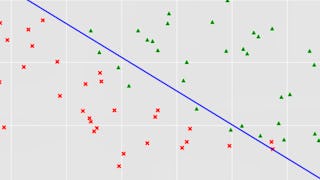
Skills you'll gain: Matplotlib, Data Visualization, Seaborn, Logistic Regression, NumPy, Data Analysis, Jupyter, Data Science, Machine Learning, Machine Learning Algorithms, Python Programming, Supervised Learning, Classification Algorithms, Algorithms
 Status: Preview
Skills you'll gain: Model Evaluation, Logistic Regression, SAS (Software), Predictive Modeling, Regression Analysis, Predictive Analytics, Feature Engineering, Analytics, Statistical Methods, Data Transformation, Statistical Modeling, Statistical Analysis, Business Analytics, Estimation, Probability
 Status: Free Trial
Skills you'll gain: Regression Analysis, Statistical Hypothesis Testing, Logistic Regression, Statistical Analysis, Analytics, Correlation Analysis, Predictive Modeling, Supervised Learning, Analysis, Statistical Modeling, Machine Learning, Model Evaluation, Variance Analysis, Classification Algorithms, Python Programming
What brings you to Coursera today?
 Status: Free Trial
Multiple educators
Skills you'll gain: Unsupervised Learning, Supervised Learning, Transfer Learning, Machine Learning, Jupyter, Applied Machine Learning, Data Ethics, Decision Tree Learning, Model Evaluation, Tensorflow, Scikit Learn (Machine Learning Library), NumPy, Predictive Modeling, Deep Learning, Artificial Intelligence, Classification Algorithms, Reinforcement Learning, Random Forest Algorithm, Feature Engineering, Data Preprocessing
 Status: Free Trial
Skills you'll gain: Unsupervised Learning, Supervised Learning, Model Evaluation, Regression Analysis, Scikit Learn (Machine Learning Library), Applied Machine Learning, Predictive Modeling, Machine Learning, Dimensionality Reduction, Decision Tree Learning, Python Programming, Logistic Regression, Classification Algorithms, Feature Engineering
 Status: Free Trial
Imperial College London
Skills you'll gain: Logistic Regression, Analytical Skills, Correlation Analysis, Regression Analysis, Sampling (Statistics), Statistical Hypothesis Testing, Data Literacy, Data Analysis, R Programming, Descriptive Statistics, Statistical Modeling, Biostatistics, Model Evaluation, Exploratory Data Analysis, Statistical Analysis, R (Software), Statistics, Statistical Methods, Data Wrangling, Public Health
 Status: Free Trial
Johns Hopkins University
Skills you'll gain: Statistical Hypothesis Testing, Sampling (Statistics), Regression Analysis, Bayesian Statistics, Statistical Analysis, Probability & Statistics, Statistical Inference, Statistical Methods, Statistical Modeling, Linear Algebra, Probability, Probability Distribution, R Programming, Biostatistics, Data Science, Statistics, Mathematical Modeling, Data Analysis, Data Modeling, Applied Mathematics
 Status: NewStatus: Free Trial
Skills you'll gain: Regression Analysis, Predictive Modeling, Model Evaluation, Statistical Modeling, Predictive Analytics, Advanced Analytics, R Programming, Statistical Methods, Data Validation, Verification And Validation, Plot (Graphics), Exploratory Data Analysis, Technical Communication
 Status: Free Trial
University of Pittsburgh
Skills you'll gain: Probability Distribution, Data Science, Probability & Statistics, Predictive Analytics, Probability, Statistical Modeling, Data Analysis, Regression Analysis, Logistic Regression, Statistical Analysis, Statistical Methods, Statistical Machine Learning, Bayesian Statistics, Statistical Inference, Feature Engineering, Applied Mathematics, Python Programming, Machine Learning, Algorithms
In summary, here are 10 of our most popular logistic regression courses
- Logistic Regression and Prediction for Health Data: University of Michigan
- Regression Models: Johns Hopkins University
- Logistic Regression in R for Public Health: Imperial College London
- Logistic Regression with NumPy and Python: Coursera
- Logistic Regression Fundamentals: Analyze & Predict: EDUCBA
- Regression Analysis: Simplify Complex Data Relationships: Google
- Machine Learning: DeepLearning.AI
- Machine Learning with Python: IBM
- Statistical Analysis with R for Public Health: Imperial College London
- Advanced Statistics for Data Science: Johns Hopkins University










