Cluster Analysis Courses
Cluster analysis courses can help you learn data segmentation, pattern recognition, and the identification of natural groupings within datasets. You can build skills in evaluating clustering methods, interpreting results, and applying statistical techniques to real-world problems. Many courses introduce tools like R, Python, and specialized software for data visualization, that support implementing clustering algorithms and analyzing complex data structures.
Popular Cluster Analysis Courses and Certifications

University of Illinois Urbana-Champaign
Skills you'll gain: Unsupervised Learning, Data Mining, Applied Machine Learning, Machine Learning Algorithms, Model Evaluation, Statistical Methods, Algorithms, Data Structures, Data Visualization

University of California, Irvine
Skills you'll gain: Model Evaluation, Unsupervised Learning, Analysis, Regression Analysis, Statistical Analysis, Data Mining, Predictive Analytics, Anomaly Detection, Fraud detection, Machine Learning, Correlation Analysis, Probability & Statistics, Scatter Plots, Market Analysis, Classification Algorithms, Collaborative Software

Skills you'll gain: Data Storytelling, Qualitative Research, Market Research, Quantitative Research, Data-Driven Decision-Making, Benchmarking, Data Presentation, Descriptive Statistics, Competitive Analysis, Analytical Skills, Research Design, Market Dynamics, Data Analysis, Data Visualization Software, Statistics, User Research, Data Collection, Data Analysis Software, Microsoft Excel, R Programming

Skills you'll gain: Customer Retention, Customer Analysis, Marketing Analytics, Customer Insights, Sample Size Determination, Analytics, User Research, Product Management, Trend Analysis, Statistical Inference, Data-Driven Decision-Making, Business Intelligence, Unsupervised Learning, Analysis, Statistical Analysis, Performance Measurement, Scikit Learn (Machine Learning Library), Strategic Decision-Making, Algorithms
 Status: Bestseller
Skills you'll gain: Pandas (Python Package), NumPy, Data Manipulation, Data Preprocessing, Package and Software Management, Data Analysis, Data Transformation, Data Integration, JSON, Object Oriented Programming (OOP), Data Wrangling, Data Science, Python Programming, Computer Programming, Programming Principles, Data Import/Export, Software Design, Mathematical Software, Computational Logic, Data Structures
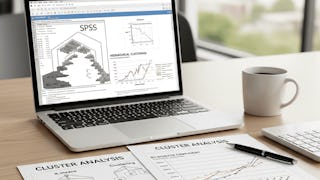
Skills you'll gain: Unsupervised Learning, SPSS, Applied Machine Learning, Machine Learning, Data Preprocessing, Machine Learning Algorithms, Statistical Analysis, Model Evaluation, Data Analysis, Statistical Methods, Data Visualization
What brings you to Coursera today?

Skills you'll gain: Data Storytelling, Data Wrangling, Data Presentation, Big Data, Data Analysis, Data Cleansing, Apache Hadoop, Statistical Analysis, Data Visualization, Apache Hive, Data Mart, Data Warehousing, Apache Spark, Data Science, Analytics, Data Lakes, Data Collection, Microsoft Excel
Skills you'll gain: Exploratory Data Analysis, Data Analysis, Data Import/Export, Data Manipulation, Data Transformation, Predictive Modeling, Data Cleansing, Data Preprocessing, Model Evaluation, Predictive Analytics, Pandas (Python Package), Regression Analysis, Feature Engineering, Statistical Analysis, Matplotlib, Scikit Learn (Machine Learning Library), Data Visualization, NumPy, Python Programming

Skills you'll gain: Exploratory Data Analysis, Data Manipulation, Statistical Analysis, R (Software), Analytical Skills, Ggplot2, Data Storytelling, R Programming, Statistical Methods, Quantitative Research, Data Visualization Software, Data Science, Data Preprocessing, Probability & Statistics, Scatter Plots, Business Analytics, Statistical Visualization, Correlation Analysis, Descriptive Statistics, Data Analysis

Skills you'll gain: Classification And Regression Tree (CART), Data-Driven Decision-Making, Minitab, Regression Analysis, Descriptive Statistics, Statistical Hypothesis Testing, Case Studies, Business Analytics, Decision Tree Learning, Predictive Analytics, Estimation, Statistical Visualization, Probability & Statistics, Microsoft Excel, Statistical Analysis, Data Visualization Software, Predictive Modeling, Data Analysis, Statistics, Analytical Skills

University of Illinois Urbana-Champaign
Skills you'll gain: Data Visualization, Data Visualization Software, Text Mining, Data Presentation, Data Mining, Interactive Data Visualization, Data Storytelling, Dashboard, Tableau Software, Plot (Graphics), Natural Language Processing, Scatter Plots, Unsupervised Learning, Data Mapping, Unstructured Data, Statistical Analysis, Vector Databases, Graphing, Predictive Analytics, Big Data

Duke University
Skills you'll gain: Bayesian Statistics, Statistical Hypothesis Testing, Sampling (Statistics), Statistical Inference, Exploratory Data Analysis, Peer Review, Regression Analysis, R (Software), Statistical Reporting, Probability Distribution, Statistical Analysis, Statistics, Data Analysis Software, Data Analysis, Probability & Statistics, Probability, R Programming, Statistical Modeling, Statistical Methods, Data Visualization
In summary, here are 10 of our most popular cluster analysis courses
- Cluster Analysis in Data Mining: University of Illinois Urbana-Champaign
- Cluster Analysis, Association Mining, and Model Evaluation: University of California, Irvine
- Market Research Methods and Data Analysis Certificate: Coursera
- User Segmentation, Experimentation, and Retention Analytics: Coursera
- Google Data Analysis with Python: Google
- SPSS: Apply & Evaluate Cluster Analysis Techniques: EDUCBA
- Introduction to Data Analytics: IBM
- Data Analysis with Python: IBM
- Analyze and Apply R for Data Analytics: EDUCBA
- Apply Statistical Data Analysis with Minitab: EDUCBA










